A buyer in Dubai or Riyadh cannot walk round the building, and the survey is the walk. It is also the document that most often changes the price or stops the purchase: one in ten surveys on London stock finds something the buyer did not know and the seller did not say. Surveys come in three levels, and the lender’s valuation is not one of them. Our guide on due diligence from abroad covers the legal side.
Buying from abroad
Surveys explained: Level 2 or Level 3, what they cost, and what they find in London stock
Survey levels explained: Level 1, Level 2 and Level 3 compared
Level 2, the former HomeBuyer Report, is a visual inspection and fits a flat in a modern tower or a portered mansion block. Level 3, the former Building Survey, is the detailed structural inspection for any house, any flat in a converted Victorian or stucco house, and anything the buyer intends to alter. In central London in 2026 a Level 2 costs £800 to £1,800 and a Level 3 £1,400 to £4,500, more above £5,000,000. A lender’s valuation is not a survey: it protects the lender and finds nothing.
The Royal Institution of Chartered Surveyors sets three levels. Level 1 is a condition report: a traffic-light summary with no advice, suitable for a new flat and not much else. Level 2, the former HomeBuyer Report, is a visual inspection of the accessible parts of the property with condition ratings, a list of defects and advice on repairs, and, if asked, a valuation; it does not lift floorboards or go into the roof space beyond the hatch.
What a Level 3 Building Survey covers and who it suits
Level 3, the former Building Survey, is a detailed inspection of the structure and fabric, with the surveyor going where access allows, a description of how the building is put together, the defects, their causes and the likely cost and urgency of repair; it is the survey for a house, a period conversion or anything the buyer intends to alter. All three are by a surveyor who owes a duty to the buyer, which a lender’s valuer does not.
Which survey level suits each kind of London property
The survey the firm recommends for each kind of London property:
Survey level by property type in London
| Property | Survey |
|---|---|
| New flat in a modern tower with a warranty | Level 2, plus written building-safety and cladding questions |
| Flat in a portered mansion block, 1900s to 1930s | Level 2, with the block’s accounts read by the solicitor |
| Flat in a converted Victorian or stucco house | Level 3 |
| Any house | Level 3 |
| A house or flat the buyer will extend, dig or rebuild | Level 3 plus a structural engineer and an architect’s view on consent |
| Off-plan, not yet built | No survey is possible; a snagging inspection at completion, as our guide on new-build warranties and snagging explains |
Source: RICS Home Survey Standard; the firm’s practice, October 2026.
How much a survey costs in central London in 2026
Indicative fees for central London in 2026:
Survey fees, central London, 2026
| Survey, central London, 2026 | Flat | House |
|---|---|---|
| Level 2 | £800 to £1,400 | £1,200 to £1,800 |
| Level 3 | £1,400 to £2,500 | £2,000 to £4,500, more above £5,000,000 |
| Structural engineer’s report, where needed | £800 to £2,000 | £1,500 to £3,500 |
| Specialist (drains CCTV, damp, timber, asbestos) | £250 to £600 each | £300 to £800 each |
Source: current London surveyors’ fee scales, indicative ranges for central London, verified 14 October 2026.
Fees rise with price and size, and a surveyor who knows the district and the estate (Grosvenor, Cadogan, Howard de Walden, Eyre) is worth the premium. The buyer instructs the surveyor directly, not through the agent, and the surveyor reports to the buyer. Our guide on the full cost of buying a London flat places the survey among the other fees.
Surveying stucco terraces in Belgravia, Kensington, Bayswater and St John’s Wood
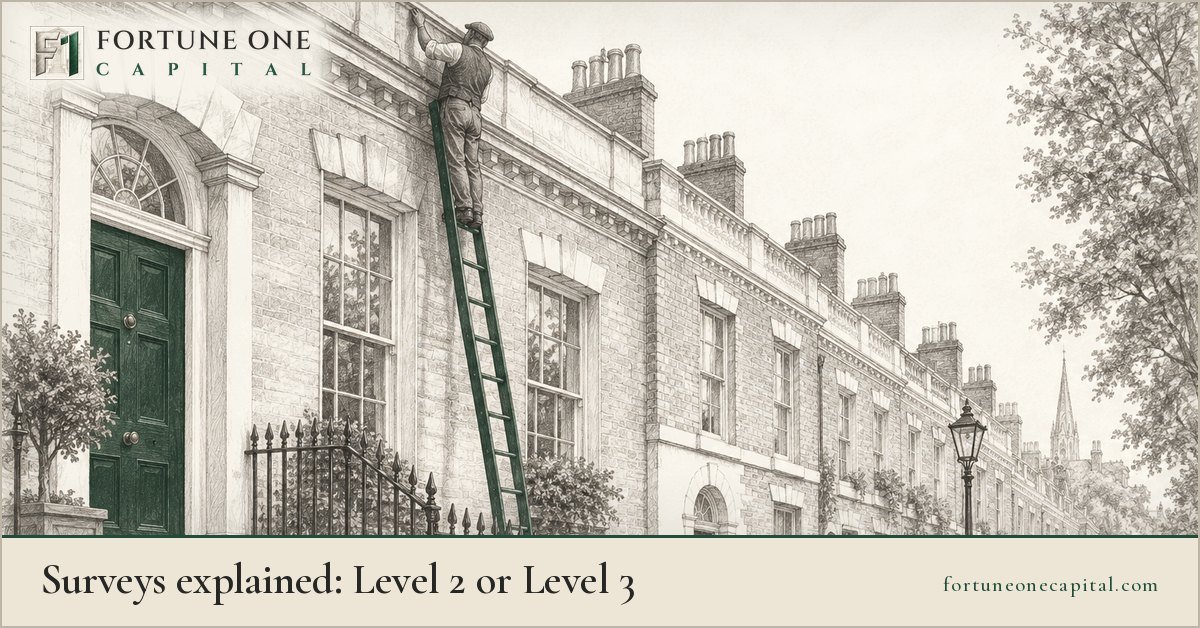
The white terraces of Belgravia, Kensington, Bayswater and St John’s Wood are brick with a render skin, and the render is the first thing a surveyor looks at: cracks, hollow patches, and the paint cycle (the estates require repainting every five to seven years and charge for it).
What a surveyor finds beneath the render of a stucco house
Beneath: London clay, which shrinks in dry summers and moves the foundations, so hairline cracks over windows are common and structural movement is not rare; basements dug since 2000, which must have consent and a structural certificate; roofs of slate or lead behind parapets, with valley gutters that block and flood the top floor; original drains under the garden that have been patched for a century; and timber floors over damp cellars.
A Level 3 on a stucco house takes a day and the report runs to sixty pages, and the firm has rarely seen one with nothing in it.
Conversions and blocks
A Victorian house converted to flats in the 1970s or 1980s was often done without consent and always done to the standards of its day: sound and fire separation between flats, the shared roof and drains, and who is responsible for what under the lease are the questions. The surveyor reports on the flat and on the common parts he can see; the solicitor reads the lease and the accounts for the rest.
What a survey checks in a London mansion block flat
In a mansion block the fabric is the freeholder’s and the service charge pays for it, so the survey is of the flat’s own condition, the windows (often the leaseholder’s), the services and the evidence of water from above; the block’s major works programme, in the lease pack, matters more than the survey, as our guide on service charges, ground rent and building safety explains.
Surveying a flat in a modern tower: cladding and building safety
A flat in a 2000s or 2020s tower is usually in good condition and the survey is short; the building is the question. The surveyor should be asked in writing for the building’s external wall status (the EWS1 form or its replacement), its position under the Building Safety Act (over 11 metres, over 18 metres, who is the accountable person, any remediation outstanding or funded), and any cladding, insulation or fire-stopping history.
A tower with unresolved remediation is unmortgageable and unsaleable until it is resolved, whatever the flat looks like. The surveyor also checks the flat’s own mechanical ventilation, the heat-network connection and meter, and the balcony’s drainage, the three things that fail in new towers.
Survey or lender’s valuation: what is the difference?
A lender’s valuation is a short visit by a valuer instructed by the lender to confirm the property is worth the loan; the buyer pays for it, may not see it, and cannot rely on it. It is not a survey, finds nothing, and protects the lender. A buyer with finance needs both: the valuation for the lender and a Level 2 or 3 for themselves, usually by a different firm. A cash buyer needs only the survey, and some skip it to save £2,000 on a £2,000,000 purchase; the firm does not act for a client who does.
How to read your survey report and follow up
The report arrives by email within a week to ten days of the inspection. Read the summary, then every item rated 3 (urgent or serious), then the surveyor’s comments on the roof, the structure, the drains and the damp, then the section on further investigations, which is where the surveyor says what he could not see. Then telephone the surveyor; a conversation of twenty minutes answers the questions the report raises and is included in the fee.
Deciding what to do after the survey report
Then decide, with the firm: proceed, renegotiate on the costed defects, obtain the specialist reports, or walk away. A seller who has priced the property to the street will usually give something for a costed defect; one who will not is telling the buyer something.
Sources: RICS home surveys · Building Safety Act 2022 (legislation.gov.uk) · Buying a home: surveys (GOV.UK). Checked against the RICS Home Survey Standard and current London surveyors’ fee scales; costs are indicative ranges for central London at that date. General information, not advice on a particular purchase; the surveyor’s report is what counts. Figures verified 14 October 2026.
Frequently Asked
Questions about London property surveys
Yes, and does: a member of the firm meets the surveyor at the property, sees what he sees, and reports to the client the same day with photographs, before the written report.
Yes. The flat is the buyer’s for twenty years; the survey costs £1,000 once and finds the bathroom leak, the failed window seals and the boiler at the end of its life that the agent’s photographs did not.
No. It was addressed to the seller and the surveyor owes you nothing; commission your own, and give the surveyor the seller’s as background if the seller will share it.
A Level 2, the former HomeBuyer Report, is a visual inspection of the accessible parts of the property with condition ratings, a list of defects and advice on repairs; it does not lift floorboards or go beyond the roof hatch. A Level 3, the former Building Survey, is a detailed inspection of the structure and fabric, with the defects, their causes and the likely cost and urgency of repair. Level 3 is the survey for a house, a period conversion or anything you intend to alter.
A Level 2 is £800 to £1,400 for a flat and £1,200 to £1,800 for a house. A Level 3 is £1,400 to £2,500 for a flat and £2,000 to £4,500 for a house, more above £5,000,000. A structural engineer’s report, where needed, adds £800 to £3,500, and specialist reports on drains, damp, timber or asbestos cost £250 to £800 each. Fees rise with price and size.
Yes. A cash buyer needs only the survey, not a lender’s valuation, but some skip it to save £2,000 on a £2,000,000 purchase. The firm does not act for a client who does. The survey is by a surveyor who owes a duty to you, and it is the document that most often changes the price or stops the purchase.
No. A lender’s valuation is a short visit by a valuer instructed by the lender to confirm the property is worth the loan; you pay for it, may not see it, and cannot rely on it. It finds nothing and protects the lender. A buyer with finance needs both: the valuation for the lender and a Level 2 or 3 for themselves, usually by a different firm.
Cracked or hollow render and the estate’s paint cycle, which requires repainting every five to seven years. Beneath that: London clay that shrinks in dry summers and moves the foundations, so hairline cracks over windows are common; basements dug since 2000 that must have consent and a structural certificate; slate or lead roofs with valley gutters that block; century-old drains; and timber floors over damp cellars. A Level 3 on a stucco house takes a day and the report runs to sixty pages.
In writing: the building’s external wall status (the EWS1 form or its replacement), its position under the Building Safety Act (over 11 metres, over 18 metres, who the accountable person is, any remediation outstanding or funded), and any cladding, insulation or fire-stopping history. A tower with unresolved remediation is unmortgageable and unsaleable until it is resolved. The surveyor should also check the flat’s mechanical ventilation, heat-network connection and meter, and balcony drainage.
It arrives by email within a week to ten days of the inspection. Read the summary, then every item rated 3 (urgent or serious), then the comments on the roof, structure, drains and damp, then the section on further investigations, where the surveyor says what he could not see. Then telephone the surveyor; a twenty-minute conversation is included in the fee. Then decide with the firm: proceed, renegotiate on the costed defects, obtain specialist reports, or walk away.