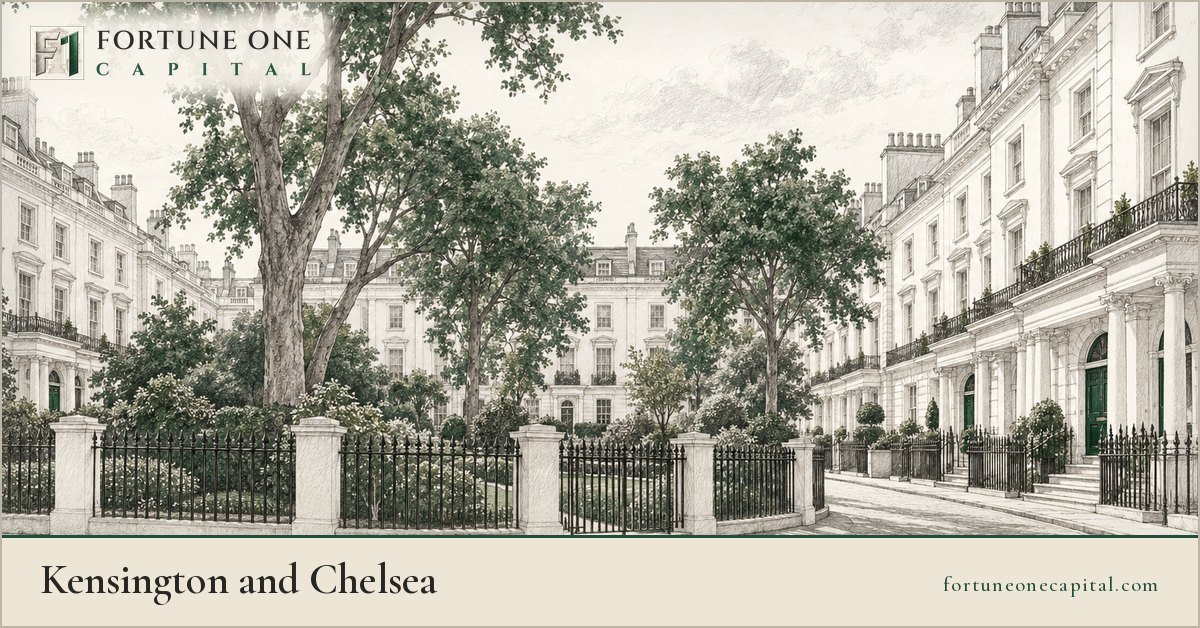
Kensington and Chelsea is the Royal Borough west of Mayfair and Knightsbridge: Kensington to the north, around Kensington Gardens and Holland Park, and Chelsea to the south, between the King’s Road and the river. It is Britain’s most expensive borough by average price, and where Gulf families most often buy Kensington and Chelsea property as a house rather than a flat, because the houses are here. The basement rules and the council tax premium are where buyers trip.
Areas
Kensington and Chelsea: a property guide for Gulf buyers
Kensington and Chelsea property: prices, rules and who buys here
Kensington and Chelsea is where a Gulf family buys the London house: a four- to five-bedroom terrace costs £5,000,000 to £15,000,000, at £1,400 to £2,300 per square foot, with Holland Park and the best squares at £2,500 to £3,200. A two-bedroom flat is £1,500,000 to £3,500,000 and yields 3 to 4 per cent gross. Prices are roughly where they were in 2014. The catch: a second home pays the 100 per cent council tax premium from 1 April 2026, and basements are limited to one storey under half the garden.
Kensington was a village beside a royal palace until the 1850s, when the Phillimore, Holland and Campden Hill estates were laid out as white stucco terraces and garden squares for the professional classes. Chelsea was older and more mixed, a riverside village of artists and soldiers that the Cadogan family’s estate rebuilt in red brick from the 1870s.
Leasehold, freehold and planning rules in Kensington and Chelsea
The Cadogan Estate still owns much of Chelsea between Sloane Street and the King’s Road, which matters to a buyer because many Chelsea flats and some houses are leasehold from the estate, as in Mayfair and Marylebone. Kensington is more often freehold. About seventy per cent of the borough is in a conservation area, and the council’s planning rules are the strictest in London: single-storey basements only, under no more than half the garden, and almost nothing on the street elevation. Buildings do not change here, which is the point.
Kensington and Chelsea property prices in autumn 2026
The indicative ranges for autumn 2026, from a stucco conversion to The Boltons:
Indicative Kensington and Chelsea prices, autumn 2026
| Property | Indicative price, autumn 2026 |
|---|---|
| One-bedroom flat in a stucco conversion | £750,000 to £1,300,000 |
| Two-bedroom flat in a mansion block or garden square | £1,500,000 to £3,500,000 |
| Three-bedroom lateral flat, portered building | £3,500,000 to £8,000,000 |
| Terraced house, four to five bedrooms, Chelsea or Kensington | £5,000,000 to £15,000,000 |
| Detached or double-fronted house, Holland Park or The Boltons | £15,000,000 to £40,000,000 and above |
| Per square foot | £1,400 to £2,300; Holland Park and the best squares £2,500 to £3,200 |
Source: Land Registry sales and current listings, October 2026; UK House Price Index, Kensington and Chelsea (HM Land Registry).
The Land Registry’s borough average is a little over £1,000,000 in the early-2026 index, which says only that the borough stretches from Ladbroke Grove to the river; prices in the streets below bear no relation to the average. In sterling, prime Kensington and Chelsea are roughly where they were in 2014, and in dollars and dirhams they are well below it. Prices have moved a few per cent either way for a decade. A buyer today is paying what a buyer paid twelve years ago for a building that has not changed.
Rental income and gross yields in Kensington and Chelsea
A two-bedroom flat in a good building lets for £4,000 to £7,000 a month, a three-bedroom lateral flat for £7,000 to £14,000, and a family house for £12,000 to £30,000. The Office for National Statistics puts the mean private rent in the borough at about £3,600 a month in its May 2026 index, which, like the average price, blends the whole borough. Gross yields on the stock a Gulf buyer considers are 3 to 4 per cent, a little above Mayfair, because the prices per square foot are lower while the rents are nearly as high.
Service charges and typical tenants for Kensington and Chelsea flats
Service charges in the stucco conversions are modest, often £3,000 to £8,000 a year; in the few new schemes they run to £12 to £16 per square foot. Tenants are corporate, diplomatic and international, with a strong French and American presence because of the schools. Our guide on letting and managing a London property from the Gulf covers what a managed let costs.
Who buys property in Kensington and Chelsea
Families, before investors. The borough is where a Gulf family buys the London house: a stucco terrace in Kensington with a garden and a mews behind it, or a red-brick house off the King’s Road with a square to walk to. Buyers come from the Gulf, from France (South Kensington is the French quarter of London, with the Lycée at its centre), from the United States, Italy, India and Nigeria.
The investor who does buy here is buying a flat in a mansion block or a garden square for a tenant who will stay five years, not for a yield. A family that expects to use the house for the summer and leave it empty for the rest of the year should read the council tax section below before offering.
Best streets to buy in Kensington
In Kensington, the Phillimore estate behind High Street Kensington (Phillimore Gardens, Upper Phillimore Gardens, Essex Villas), Campden Hill and the streets around Holland Park (Holland Park itself, Holland Villas Road, Addison Road) for the large houses; Kensington Square and Edwardes Square for Georgian character; Kensington Palace Gardens is the most expensive street in the country and effectively an embassy row, not a market.
Best streets and squares to buy in Chelsea
In Chelsea, the Cadogan squares (Cadogan Square, Cadogan Gardens) for portered lateral flats; Egerton Crescent, Egerton Terrace and the Thurloe estate for stucco houses near the museums; The Boltons and Tregunter Road for the biggest houses; Cheyne Walk and Chelsea Square for the river and the old village; Markham Square, Wellington Square and Paultons Square off the King’s Road for family houses at a price below the squares north of it.
The Earl’s Court end, the streets south of Cromwell Road towards West Brompton, and Chelsea Harbour are cheaper for reasons the resale market has not forgotten.
Transport and Tube links in Kensington and Chelsea
South Kensington and Gloucester Road are on the Piccadilly line, which runs direct to Heathrow in about fifty minutes; the District and Circle lines serve South Kensington, Sloane Square and High Street Kensington; Notting Hill Gate adds the Central line. There is no Elizabeth line station in the borough, which is why Mayfair and Marylebone reach Heathrow faster despite being further east.
Walking, parking and driving in Kensington and Chelsea
Most of Chelsea is a walk to Harrods and Sloane Street; Kensington is a walk to Hyde Park and Kensington Gardens. Parking is by residents’ permit, and a house with a garage or off-street space, rare in the terraces, commands a clear premium. The Cromwell Road and the Embankment carry the borough’s traffic, and the streets between them are quiet.
Schools and universities near Kensington and Chelsea homes
The borough has more independent preparatory schools per square mile than anywhere in Britain: Hill House, Garden House, Sussex House, Falkner House, Glendower, Kensington Prep and Thomas’s Kensington among them, with the Lycée Français Charles de Gaulle in South Kensington drawing French and bilingual families. Imperial College is in South Kensington, and the Royal College of Art and Royal College of Music beside it, which is why a flat near the museums lets so readily to a graduate student’s family.
Hospitals in Kensington and Chelsea for Gulf families
For a Gulf family the hospitals matter as much as the schools: the Cromwell Hospital on Cromwell Road has treated patients from the Gulf for forty years and has Arabic-speaking staff, the Royal Marsden and the Royal Brompton are in Chelsea, and the Lister is at Chelsea Bridge. Harley Street is twenty minutes by car.
Our view on buying in Kensington and Chelsea
Kensington and Chelsea is for the family house. The value is in a freehold stucco or red-brick house on a quiet square or a garden street, bought at the per-square-foot price of its neighbours, with a lease pack that is clean or a freehold that is unencumbered, rather than in a new scheme at a premium the borough’s resale market does not yet pay. For a flat, a portered mansion block on one of the Cadogan squares or a lateral conversion in a Kensington terrace holds value better than a new tower on the river.
Council tax premium on second homes in Kensington and Chelsea
Two warnings. First, the borough charges the 100 per cent council tax premium on second homes from 1 April 2026, having charged nothing in 2025/26; it has about 7,900 second homes and expects nearly £8,000,000 a year from them. A Band H house that paid £3,333 pays £6,666, which is modest against the price of the house and still a line to budget, as our guide on council tax on a London second home explains.
Basement rules and limits on extending a Kensington house
Second, the basement rules mean a house cannot be enlarged the way buyers from the Gulf often expect; buy the space that exists. We have walked these streets for years and will say plainly which houses have been dug, which leases are short and which squares flood.
Sources: UK House Price Index, Kensington and Chelsea (HM Land Registry) · Private rent and house prices, UK (ONS, May 2026) · RBKC 2026/27 Budget and Council Tax Report · RBKC basements planning policy · Leasehold and Freehold Reform Act 2024 (legislation.gov.uk). Checked against the UK House Price Index and the Office for National Statistics private rent index; prices, rents and yields are indicative ranges for that date, drawn from Land Registry sales and current listings, and vary by building and street. Council tax premium figures from the Royal Borough’s 2026/27 budget report. General information, not advice on a particular purchase. Figures verified 14 October 2026.
Frequently Asked
Questions about buying in Kensington and Chelsea
Kensington, for the gardens and the parks, if the children are young; Chelsea, for the King’s Road and the river, if they are older. Both are quiet in August when the schools are out.
One storey, under no more than half the garden, with a planning application that takes months and neighbours who object. The borough’s basement policy has been in force since 2015. Buy the house with the basement already dug, or buy the space you need.
In Chelsea, most are, from the Cadogan Estate or a private freeholder, with leases now extendable by 990 years under the 2024 Act. In Kensington, more are share of freehold. Our guide on leasehold or freehold for an overseas buyer explains what to check before offering, and our guide on stamp duty for overseas buyers gives the duty on the prices above.
A four- to five-bedroom terraced house is £5,000,000 to £15,000,000 in autumn 2026; a detached or double-fronted house in Holland Park or The Boltons is £15,000,000 to £40,000,000 and above. Per square foot the borough runs £1,400 to £2,300, with Holland Park and the best squares at £2,500 to £3,200. The Land Registry’s borough average of a little over £1,000,000 bears no relation to these streets.
Barely. In sterling, prime Kensington and Chelsea are roughly where they were in 2014, and in dollars and dirhams they are well below it. Prices have moved a few per cent either way for a decade. A buyer today is paying what a buyer paid twelve years ago for a building that has not changed.
A two-bedroom flat in a good building lets for £4,000 to £7,000 a month, a three-bedroom lateral flat for £7,000 to £14,000, and a family house for £12,000 to £30,000. Gross yields are 3 to 4 per cent, a little above Mayfair. Tenants are corporate, diplomatic and international, with a strong French and American presence because of the schools.
The borough charges the 100 per cent premium on second homes from 1 April 2026, having charged nothing in 2025/26. A Band H house that paid £3,333 pays £6,666. The council has about 7,900 second homes and expects nearly £8,000,000 a year from them. Our guide on council tax on a London second home explains.
Modest in the stucco conversions, often £3,000 to £8,000 a year. In the few new schemes they run to £12 to £16 per square foot. A portered mansion block on one of the Cadogan squares or a lateral conversion in a Kensington terrace holds value better than a new tower on the river.
About fifty minutes direct on the Piccadilly line from South Kensington or Gloucester Road. There is no Elizabeth line station in the borough, which is why Mayfair and Marylebone reach Heathrow faster despite being further east. Harley Street is twenty minutes by car.
The Cromwell Hospital on Cromwell Road has treated patients from the Gulf for forty years and has Arabic-speaking staff. The Royal Marsden and the Royal Brompton are in Chelsea, and the Lister is at Chelsea Bridge. For a Gulf family the hospitals matter as much as the schools.