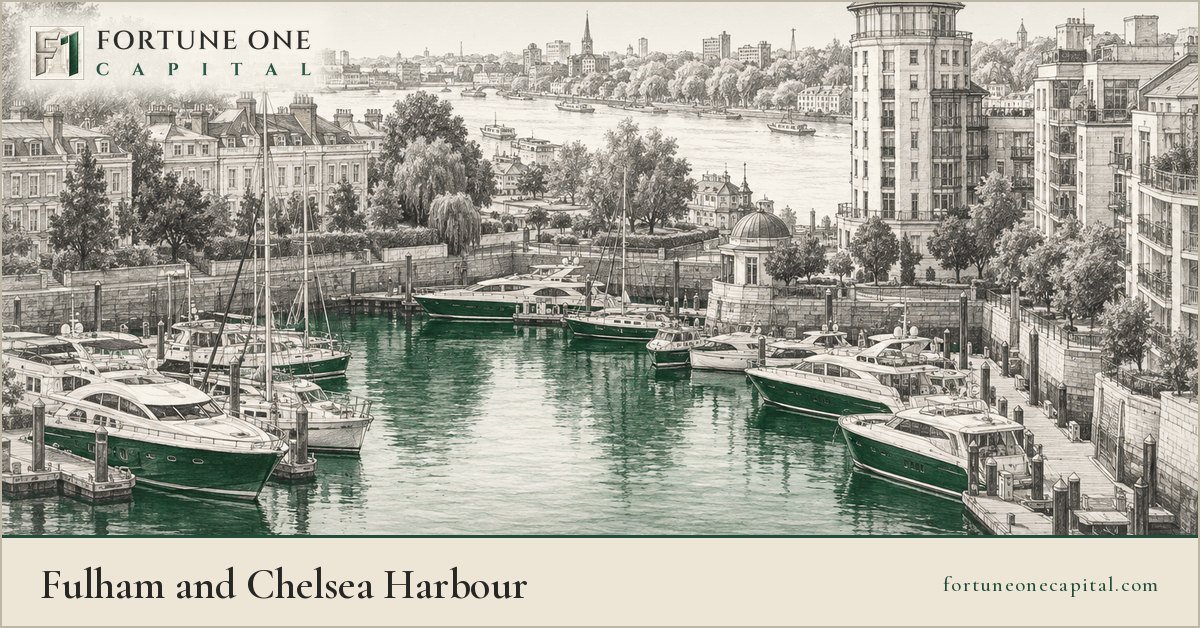
Fulham is the district west of Chelsea where the stucco gives way to Victorian terraces on a grid. It has been Chelsea’s overflow for forty years, with the schools, the river and the parks families want and prices half of Chelsea’s. Chelsea Harbour and Imperial Wharf, on the river at its eastern edge, are its towers: marina flats with porters, the nearest thing west London has to Dubai Marina, and priced as such.
Areas
Fulham and Chelsea Harbour: a property guide for Gulf families who want Chelsea’s neighbour
Fulham property for Gulf families: a quick guide to the district
Fulham is the family-house district for a Gulf family that wants Chelsea with half the money: a four-bedroom Victorian terrace on the Alphabet streets costs £1,800,000 to £3,000,000 against £4,000,000 to £6,000,000 across the border. Chelsea Harbour and Imperial Wharf are the lock-up-and-leave answer, two-bedroom flats at £900,000 to £1,800,000 with service charges of £8 to £14 per square foot. Gross yields are 3.5 to 4.5 per cent. The catch: it is not an Arabic-speaking district, and the newer riverside towers are still proving their value.
Fulham runs from Chelsea’s border at Stamford Bridge west to Hammersmith and south to the river’s bend at Putney Bridge: Parsons Green and the “Alphabet streets” between the New King’s Road and the river, the Peterborough estate’s “Lion houses”, Hurlingham’s quiet streets by the club, Fulham Broadway and the streets north of it, and the river frontage from Chelsea Harbour through Imperial Wharf to Fulham Reach.
Fulham housing stock: Victorian terraces, riverside towers and the borough
The housing is mid-Victorian terraces, three to five storeys, mostly freehold and mostly conservation area, with the riverside towers of the 1990s to 2020s on leases from their developers. Hammersmith and Fulham is the borough; its planning is less severe than Kensington’s and basements are more often approved.
Prices
The indicative ranges for autumn 2026:
Indicative Fulham and Chelsea Harbour prices, autumn 2026
| Property | Indicative price, autumn 2026 |
|---|---|
| Two-bedroom flat in a conversion | £650,000 to £950,000 |
| Two-bedroom flat at Chelsea Harbour or Imperial Wharf | £900,000 to £1,800,000 |
| Victorian terraced house, four bedrooms, Parsons Green or the Alphabet streets | £1,800,000 to £3,000,000 |
| Lion house or Hurlingham house, five to six bedrooms | £3,000,000 to £6,000,000 |
| Chelsea Harbour penthouse or Belvedere tower flat | £3,000,000 to £8,000,000 |
| Per square foot | £1,000 to £1,400 for houses; £1,200 to £1,800 at the riverside schemes |
Source: Land Registry sales and current listings, October 2026; ONS housing prices in Hammersmith and Fulham, July–August 2026.
The Office for National Statistics puts Hammersmith and Fulham’s average at about £738,000 in July 2026, down 9 per cent on the provisional figure; the family houses have been steadier than the flats. The same four-bedroom house across the border in Chelsea is £4,000,000 to £6,000,000.
Fulham rents and rental yields for investors
A two-bedroom flat lets for £2,800 to £4,000 a month, a riverside two-bedroom for £3,500 to £5,500, a four-bedroom house for £5,500 to £9,000, and a Lion house for £9,000 to £15,000; the borough’s mean private rent was about £2,825 in August 2026. Gross yields are 3.5 to 4.5 per cent, with the riverside flats at the top of that range and the houses at the bottom; the tenant market is corporate families, embassy and finance tenants, and the Imperial and Lycée families.
Service charges at Chelsea Harbour and Imperial Wharf
Service charges at Chelsea Harbour and Imperial Wharf are £8 to £14 per square foot with the porter and the marina. Our London yields guide gives the borough figure.
Who buys property in Fulham and Chelsea Harbour
Families leaving Chelsea for a fourth bedroom and a garden; American and European corporate families; and a Gulf presence that is small on the terraces and real at Chelsea Harbour, which has been a Gulf address since it opened in the 1980s, with the Harbour Club, the hotel and the marina. The riverside flats are bought by Gulf investors for the porter and the river and by families for a London base they can lock and leave, as our pied-à-terre guide describes; the terraces are bought by families who will live in them. Fulham is not an Arabic-speaking district and is twenty-five minutes from Edgware Road.
Best streets to buy in Fulham, and which to avoid
Parsons Green and the Alphabet streets (Bradbourne, Chipstead, Dorncliffe and their neighbours between the New King’s Road and the river) for the best Victorian houses; the Peterborough estate’s Lion houses, with their stone lions on the gateposts, for the largest; Hurlingham’s streets by the club for quiet and the river; the Moore Park estate by Stamford Bridge for proximity to Chelsea; Munster Village and the streets off Fulham Road for value. Avoid the flats on the main roads (Fulham Road, New King’s Road, Wandsworth Bridge Road), the streets nearest the football ground on match days, and the north of the district beyond Lillie Road, where the market changes.
Chelsea Harbour, Imperial Wharf and Fulham Reach riverside schemes
Chelsea Harbour (1986 onwards): a marina, the Belvedere tower, the Chelsea Harbour Hotel, the Design Centre, and flats with porters, parking and views, on leases with service charges to match. Imperial Wharf (2000s onwards): a larger scheme of towers and squares with its own station and a riverside park, cheaper per foot and more rental. Fulham Reach and the Hammersmith end: newer towers near the bridge.
Why the riverside is a different market from Fulham terraces
The riverside is a different market from the terraces: an investor’s and a lock-up-and-leave buyer’s, priced on the porter and the view, with the service charges and the resale questions of any new scheme that our off-plan guide sets out. Chelsea Harbour has held value well since the 1990s; the newer towers are still proving it.
Getting about from Fulham: Tube, Overground, Heathrow and river bus
Parsons Green, Fulham Broadway and Putney Bridge on the District line (South Kensington in twelve minutes, Victoria in twenty); Imperial Wharf on the Overground (Clapham Junction in four minutes, and so Gatwick, and West Brompton for the District line); Heathrow by car in thirty-five to forty minutes along the A4, or by the Piccadilly line from Hammersmith in forty. The river bus from Chelsea Harbour pier to the City. Most houses have no off-street parking and permit parking is the norm; the riverside schemes have garages. Harrods is twenty minutes by car, Harley Street thirty-five.
Schools in Fulham and Parsons Green for families
The reason Parsons Green is full of families: Thomas’s Fulham, Fulham Prep, Kensington Prep’s Fulham site, the Lycée’s Fulham campus (the French presence in Fulham is large), Eridge House, Parsons Green Prep, and the Harrodian and St Paul’s across the river in Barnes; Lady Margaret and the London Oratory for senior day places. Imperial is twelve minutes by the District line, which makes a Fulham flat a reasonable student purchase at a lower price than South Kensington; our schools and universities guide maps the district.
Our view on buying a family house in Fulham
Fulham is for the family house: a Victorian terrace on the Alphabet streets or the Peterborough estate, freehold, with a garden and a school in walking distance, bought at the street’s price per foot and extended at the back and into the loft where the borough’s planning allows, which it usually does. It is the best value family district within a walk of Chelsea and the firm sends there the families who come to it wanting Chelsea and having half the money.
Our view on Chelsea Harbour and the riverside towers
Chelsea Harbour is a separate answer for a family that wants a porter, a marina and a lock-up-and-leave flat with a river view, and will pay the service charge for it; the newer riverside towers are investments to be bought completed at resale prices, as our off-plan guide explains, not reservations.
Sources: Housing prices in Hammersmith and Fulham (ONS, July–August 2026) · UK House Price Index (HM Land Registry) · Planning permission (GOV.UK). Checked against the Office for National Statistics local housing figures; prices, rents and yields are indicative ranges for that date, drawn from Land Registry sales and current listings, and vary by street and scheme. General information, not advice on a particular purchase. Figures verified 14 October 2026.
Frequently Asked
Questions about Fulham and Chelsea Harbour
The residential grids are among the quietest in inner London; the main roads and the football ground are not. Buy on the grids.
Chelsea Harbour is older, proven, on the Chelsea side and cheaper per foot; Battersea is newer, larger, with better transport and higher service charges. Our Battersea guide sets out the other side.
Usually: a rear extension, a loft conversion and often a basement are approved in Hammersmith and Fulham where Kensington would refuse, which is one reason the houses are good value; our planning guide explains the regimes.
A four-bedroom Victorian terrace in Parsons Green or the Alphabet streets is £1,800,000 to £3,000,000, and a Lion house or Hurlingham house with five to six bedrooms £3,000,000 to £6,000,000. The same four-bedroom house across the border in Chelsea is £4,000,000 to £6,000,000. Houses run at £1,000 to £1,400 per square foot, and the family houses have been steadier than the flats.
A two-bedroom flat lets for £2,800 to £4,000 a month, a riverside two-bedroom for £3,500 to £5,500, a four-bedroom house for £5,500 to £9,000 and a Lion house for £9,000 to £15,000. The borough’s mean private rent was about £2,825 in August 2026. Gross yields are 3.5 to 4.5 per cent, with the riverside flats at the top of the range and the houses at the bottom. Tenants are corporate, embassy and finance families and the Imperial and Lycée families.
Parsons Green and the Alphabet streets between the New King’s Road and the river for the best Victorian houses; the Peterborough estate’s Lion houses for the largest; Hurlingham’s streets by the club for quiet; the Moore Park estate for proximity to Chelsea; Munster Village and the streets off Fulham Road for value. Avoid flats on the main roads, the streets nearest the football ground, and the north of the district beyond Lillie Road.
£8 to £14 per square foot a year at Chelsea Harbour and Imperial Wharf, which pays for the porter and the marina. Chelsea Harbour, built from 1986, has held value well since the 1990s and has been a Gulf address since it opened; the newer towers at Imperial Wharf and Fulham Reach are cheaper per foot and still proving their value.
Parsons Green, Fulham Broadway and Putney Bridge are on the District line, with South Kensington in twelve minutes and Victoria in twenty. Imperial Wharf is on the Overground, four minutes to Clapham Junction and so Gatwick. Heathrow is thirty-five to forty minutes by car along the A4. Harrods is twenty minutes by car and Harley Street thirty-five. Most houses have permit parking only; the riverside schemes have garages.
Yes. Imperial is twelve minutes by the District line, which makes a Fulham flat a reasonable student purchase at a lower price than South Kensington. A two-bedroom conversion flat is £650,000 to £950,000. Our schools and universities guide maps the district.