Buyers from the Gulf are used to one kind of ownership: you buy the apartment and own it outright. Most London flats are not sold that way. They are leasehold, a long tenancy of the flat inside a building that someone else owns, and the terms of that lease decide what the flat is worth, what it costs to run and whether a bank will finance it. Get the lease wrong and you own a liability with a view.
Buying from abroad
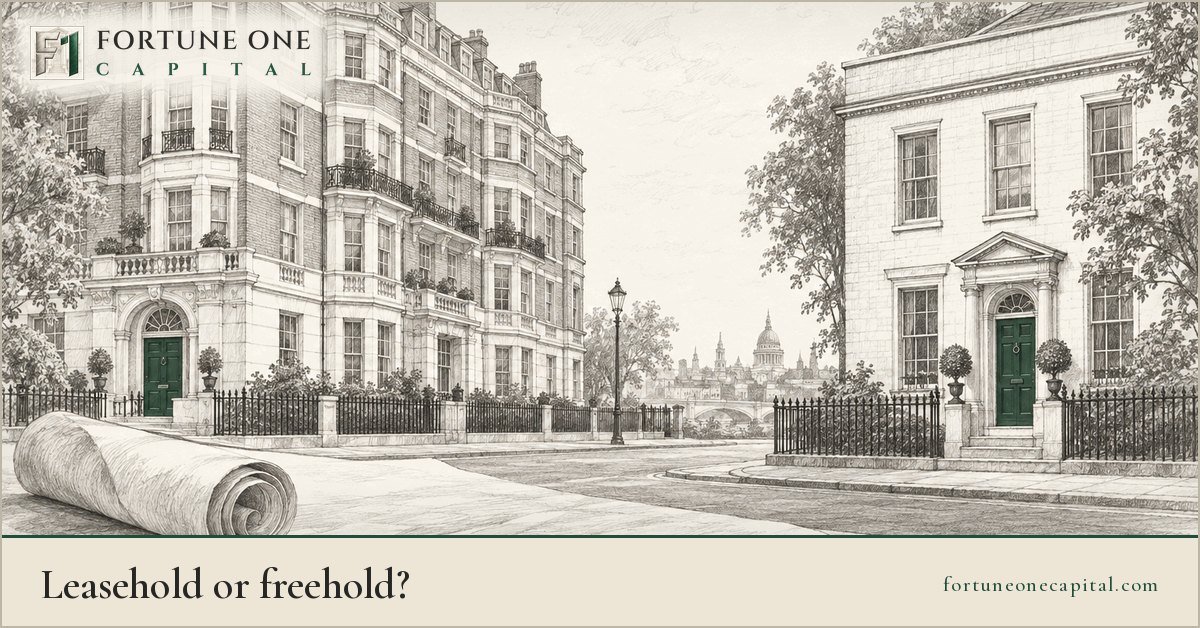
Leasehold or freehold? What an overseas buyer must understand before offering on a London flat
Freehold, leasehold and share of freehold compared for London flats
Most London flats are leasehold: you own the flat for the term of the lease, typically 99, 125 or 999 years, under a contract with the freeholder. A flat with 150 years left is worth almost as much as freehold; one with 70 years is worth markedly less and harder to finance, and most lenders want at least 80 to 85 years remaining at the end of the mortgage term. Do not buy under about 90 years without pricing the extension into the offer.
The three forms of ownership a London buyer will meet:
- Freehold. You own the land and the building on it, without time limit. Houses are usually freehold. A flat on its own almost never is, because the flats in a building depend on each other for the roof, the walls and the stairs.
- Leasehold. You own the flat for the term of the lease, typically 99, 125 or 999 years from when the lease was granted, under a contract with the freeholder. The lease sets the rights and the obligations: the ground rent, the share of the building’s costs you pay, what you may alter, whether you may let the flat.
- Share of freehold. The leaseholders together own the freehold, usually through a company in which each flat holds a share. Each flat still has a lease, but the owners are their own freeholder: they set the service charge, appoint the managing agent and can grant themselves long leases. For a block of six to twenty flats this is the form buyers from abroad like best.
Why lease length matters when buying a London flat
A lease is a wasting asset. A flat with 150 years left is worth almost as much as the same flat freehold; one with 70 years left is worth markedly less, is harder to finance, and will cost a substantial premium to extend. Most lenders want at least 80 to 85 years remaining at the end of the mortgage term. The practical rule for a buyer who wants a liquid asset: do not buy under about 90 years without pricing the extension into the offer, and prefer leases above 125 years or share of freehold.
Extensions are a statutory right. Since 31 January 2025 a leaseholder no longer has to own the flat for two years before claiming one, so an extension can be started on the day you complete. Legislation passed in 2024 provides for longer extensions and a cheaper valuation basis; those parts are being brought into force in stages, and your solicitor will confirm the position that applies on the day. The premium depends on the years left, the ground rent and the value of the flat, and is agreed or decided by a tribunal.
Ground rent and service charge on a London leasehold flat
Ground rent is a payment to the freeholder for nothing in particular. On leases granted since 30 June 2022 it must be a peppercorn, that is nil. On older leases it can be a few hundred pounds a year or, in a minority of leases sold in the 2000s and 2010s, a sum that doubles every ten or fifteen years, which lenders refuse and which must be bought out before purchase. Read the ground rent clause before anything else.
Service charge is the real running cost: your share of insuring, cleaning, heating, lifting, porterage and repairing the building. In a Mayfair or Knightsbridge block with a porter it can run to several pounds per square foot a year, so a 1,500 square foot flat may carry a five-figure annual bill. The charge is set by the freeholder or the owners’ company, must be reasonable, and can be challenged. The last three years of accounts, the current budget and the reserve fund tell you whether a block is well run or about to levy a large demand for a new roof.
Building safety rules for tall London blocks after Grenfell
After the Grenfell fire, legislation in 2022 changed who pays to fix unsafe cladding and other fire defects in taller buildings. Qualifying leaseholders in buildings over 11 metres are largely protected from those costs, and a building needs a certificate showing its status before lenders and buyers will proceed. For a buyer from abroad the practical point is that a tall block without the right paperwork is unfinanceable and illiquid, however good the view. We check it before the offer.
What a London lease allows on letting, alterations and use
The lease governs letting, alterations and use. Most London leases allow letting on assured shorthold tenancies and forbid short lets of the holiday kind, and many require the freeholder’s consent and a fee for each tenancy. Structural alterations, a new kitchen in a different place, even wooden floors in some blocks, need consent. A buyer who intends to let the flat while abroad must read these clauses before offering, because they decide whether the plan works at all.
The five lease checks to make before offering on a flat
The five checks the firm makes before any client offers on a flat:
- Years remaining: the years left on the lease, and the cost of extending if under 90.
- The ground rent clause: amount, review pattern, and whether it is a peppercorn.
- Service charge accounts: three years of accounts, the current budget, the reserve fund and any planned major works.
- Freeholder and manager: who the freeholder is and who manages the block, or whether the owners hold the freehold themselves.
- Letting, alterations and safety: the letting and alteration clauses, and the building safety paperwork for any block over 11 metres.
These five take a solicitor a few days once the seller’s pack arrives, and they are the difference between a flat that is an asset and one that is a liability with a view.
Related guides: Service charges, ground rent and building safety, Due diligence on a London property when you live abroad and Houses or flats.
Sources: Leasehold property (GOV.UK) · Leasehold and Freehold Reform Act 2024 (legislation.gov.uk) · Building Safety Act 2022 (legislation.gov.uk). Leasehold law is being reformed in stages; the position on the day of your purchase is confirmed by your solicitor, and nothing here is legal advice. Figures verified 13 October 2026.
Frequently Asked
Questions about leasehold and freehold flats in London
No. It is the normal form of flat ownership here, it is well regulated, and a long lease in a well-run block is a sound asset. The risk sits in short leases, bad ground rent clauses and badly managed buildings, all of which can be seen in advance.
Yes, and investors do. Buying a freehold block with the flats inside it gives full control and, for six or more units bought together, a different stamp duty treatment. Our stamp duty guide covers that.
For value and finance, yes. You still have a lease with obligations in it, so the service charge and the letting clauses still apply.
Most lenders want at least 80 to 85 years remaining at the end of the mortgage term. The firm’s practical rule for a buyer who wants a liquid asset is not to buy under about 90 years without pricing the extension into the offer, and to prefer leases above 125 years or share of freehold. A flat with 150 years left is worth almost as much as the same flat freehold; one with 70 years is worth markedly less.
Yes. Extensions are a statutory right, and since 31 January 2025 a leaseholder no longer has to own the flat for two years before claiming one, so the process can start on the day you complete. The premium depends on the years left, the ground rent and the value of the flat, and is agreed or decided by a tribunal. The 2024 legislation on longer extensions and a cheaper valuation basis is being brought into force in stages.
Ground rent is a payment to the freeholder for nothing in particular. On leases granted since 30 June 2022 it must be a peppercorn, that is nil. On older leases it can be a few hundred pounds a year or, in a minority of leases sold in the 2000s and 2010s, a sum that doubles every ten or fifteen years. Lenders refuse those, and the clause must be bought out before purchase. Read the ground rent clause before anything else.
In a Mayfair or Knightsbridge block with a porter it can run to several pounds per square foot a year, so a 1,500 square foot flat may carry a five-figure annual bill. The charge must be reasonable and can be challenged. The last three years of accounts, the current budget and the reserve fund show whether a block is well run or about to levy a large demand for a new roof.
Usually, but the lease decides. Most London leases allow letting on assured shorthold tenancies and forbid short lets of the holiday kind, and many require the freeholder’s consent and a fee for each tenancy. Structural alterations, and even wooden floors in some blocks, need consent too. Read the letting and alteration clauses before offering, because they decide whether the plan works at all.
After the Grenfell fire, legislation in 2022 changed who pays to fix unsafe cladding and fire defects in taller buildings. Qualifying leaseholders in buildings over 11 metres are largely protected from those costs, and a building needs a certificate showing its status before lenders and buyers will proceed. A tall block without the right paperwork is unfinanceable and illiquid, however good the view, so the firm checks it before the offer.
The leaseholders together own the freehold, usually through a company in which each flat holds a share. Each flat still has a lease, but the owners are their own freeholder: they set the service charge, appoint the managing agent and can grant themselves long leases. For a block of six to twenty flats it is the form buyers from abroad like best.