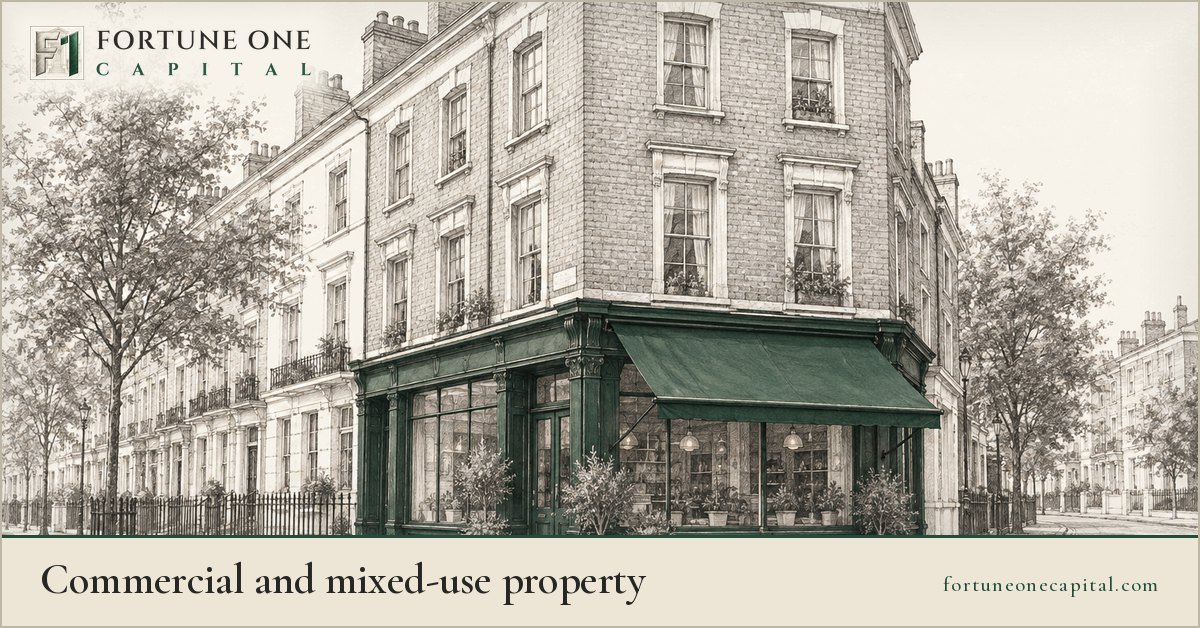
The buildings on Marylebone High Street, the King’s Road and Edgware Road are mixed-use: a shop or restaurant on the ground floor, two or three flats above, one freehold. Gulf investors have bought them for decades, for the income and the stamp duty, a fraction of a flat’s. Commercial and mixed-use property plays by different rules on tax, VAT, leases and rates. For a private investor with £2,000,000 to £20,000,000, buying for the stamp duty alone buys a problem.
Buying from abroad
Commercial and mixed-use property in London for a Gulf investor: the shop below, the flats above, and the different rules
Why mixed-use property suits a Gulf investor in London
Mixed-use property suits a Gulf investor with £2,000,000 to £20,000,000 who understands the commercial tenant’s business and can carry a void. The whole purchase is taxed at non-residential stamp duty rates, 0 per cent to £150,000, 2 per cent to £250,000 and 5 per cent above, with no additional-property, non-resident or company surcharges: £139,500 on a £3,000,000 building. Yields run 4.5 to 6 per cent gross. The catch is VAT at 20 per cent on an opted commercial element, and business rates of £20,000 to £40,000 a year during a void.
Income from two markets in one building, the commercial unit often paying as much as the flats; a purchase taxed at non-residential rates; a freehold, not a lease; and, in the central districts, scarcity, since the high streets of the estates do not grow. Against that: a commercial tenant that fails leaves an empty unit with rates to pay; the flats above a restaurant let for less; the building needs managing as two things; and the market for the whole is thinner than for a flat. The investor who understands retail or offices buys well; the one who buys for the stamp duty alone buys a problem.
Stamp duty on mixed-use property at non-residential rates
A purchase that includes any non-residential element is taxed at the non-residential rates on the whole price: 0 per cent to £150,000, 2 per cent to £250,000 and 5 per cent above, with no 5 per cent additional-property rate, no 2 per cent non-resident surcharge and no 17 per cent company rate. A £3,000,000 building with a shop and three flats pays £139,500; the three flats bought separately as residential purchases by a non-resident would pay far more, and our stamp duty guide gives the bands.
What HMRC accepts as a genuine mixed-use purchase
HMRC looks closely at mixed-use claims: the commercial element must be real, let or genuinely lettable as such, not a garage called a shop; a flat with a paddock is the classic failed claim. Buying six or more flats in one transaction is also non-residential under the rule in our block guide.
VAT on commercial and residential property in London
Residential property is exempt from VAT on sale and letting. Commercial property is exempt unless the owner has “opted to tax” it, in which case the sale price and the rent carry VAT at 20 per cent, which the owner charges, accounts for and can recover on its own costs.
Buying a building where the seller has opted to tax
A buyer of a building the seller has opted must pay VAT on the commercial element of the price (recoverable only if the buyer registers and opts in turn), or structure the purchase as a transfer of a going concern where the building is let; and stamp duty is charged on the VAT-inclusive price. The flats above are outside the option. A Gulf buyer’s accountant must look at the VAT position before the offer, because a 20 per cent surprise on the commercial element is a transaction-ending figure.
Commercial leases for shops and offices in London
A shop or office is let on a commercial lease of five to fifteen years, usually on full repairing and insuring terms (the tenant repairs the unit and reimburses the insurance), with rent reviews every five years (upward-only or to market), a break clause the tenant may exercise, and security of tenure under the Landlord and Tenant Act 1954 unless excluded, which gives the tenant a right to renew at the end.
Commercial landlord and tenant relationship and the tenant covenant
The Renters’ Rights Act does not apply; the relationship is commercial and contractual, and the landlord’s remedies for arrears (forfeiture, commercial rent arrears recovery) are stronger than for a flat. The lease and the tenant’s covenant are the asset: a fifteen-year lease to a national chain is worth more than the same unit let to a start-up on three years, whatever the rent.
Business rates on a commercial unit and void risk
The commercial unit pays business rates, a tax on its rateable value, paid by the tenant while let and by the owner while empty, after three months’ relief for most units; on a Marylebone shop the owner’s exposure during a void can be £20,000 to £40,000 a year. The flats pay council tax. An investor should price the void risk into the yield and prefer a unit with a tenant whose business is sound to one with a higher rent and a weaker tenant.
Mixed-use and commercial yields and the tenant covenant
Mixed-use buildings in central London trade at 4.5 to 6 per cent gross on the whole, the commercial element at 5 to 7 and the flats at 3.5 to 4.5; wholly commercial property at 5 to 8 depending on the tenant, the lease length and the location, with prime West End offices at the low end and secondary shops at the high.
The yield is a function of the covenant: the same shop let to a bank at 4.5 per cent and to an independent café at 7 per cent is the same bricks and a different risk. Valuers price on the lease; buyers should read it, and the tenant’s accounts, before the building.
Finance for commercial and mixed-use property, including Sharia-compliant options
Commercial lenders lend 50 to 65 per cent of value on mixed-use and commercial property, at base plus 2 to 4 per cent, to a company borrower, with the loan sized on the rental income and the lease terms; the private banks lend on relationship; Sharia-compliant finance for commercial property is available from Gatehouse and the Gulf banks’ London branches on a commodity murabaha or ijara basis, and much of London’s commercial stock is already held that way. The lender’s valuation and due diligence take three months and duplicate the buyer’s; our remortgaging guide’s timetable applies.
Converting commercial property to residential flats in London
A commercial building can sometimes be converted to flats under permitted development rights (offices to residential, with prior approval, subject to space standards and the borough’s exclusions, which in the central boroughs are extensive) or with planning permission, and the gain can be large: an office at £800 per square foot becomes flats at £1,500.
Why commercial to residential conversions often disappoint investors
The central boroughs resist the loss of commercial space, the conversion costs are high, the stamp duty on the purchase was non-residential and the sale of the flats is residential, and the firm has seen more investors lose on conversions than make the gain. A conversion is a development business, not an investment, and should be entered as one with a developer partner.
Our view on mixed-use property for Gulf investors
Mixed-use suits a Gulf investor who wants a freehold building in a central district, understands the commercial tenant’s business, can carry a void, and has an accountant for the VAT; on those terms a Marylebone or Chelsea building with a sound tenant below and three flats above is one of the best holdings in London, taxed lightly on the way in and let to two markets. Wholly commercial property suits the family office with a manager, not the private buyer. And nobody should buy a shop because the stamp duty on the flat above it is lower.
Sources: Stamp Duty Land Tax: non-residential and mixed-use rates (GOV.UK) · VAT on land and property: option to tax (GOV.UK) · Business rates relief: empty properties (GOV.UK) · Landlord and Tenant Act 1954 (legislation.gov.uk) Figures verified 14 October 2026.
Frequently Asked
Questions about commercial and mixed-use property in London
No. The whole purchase is taxed at the non-residential rates, with no residential surcharges, provided the commercial element is genuine.
Yes; the flat is yours. If it is held through a company, the Annual Tax on Enveloped Dwellings may apply to it, as our company guide explains, and the company’s letting relief for the flat is lost.
The lease ends or is forfeited, the unit is empty, and after three months the owner pays the business rates until a new tenant signs; price that into the yield and prefer the better covenant.
£139,500. A purchase that includes any non-residential element is taxed at the non-residential rates on the whole price: 0 per cent to £150,000, 2 per cent to £250,000 and 5 per cent above, with no 5 per cent additional-property rate, no 2 per cent non-resident surcharge and no 17 per cent company rate. Our stamp duty guide gives the residential bands for comparison.
Only on the commercial element, and only if the seller has opted to tax it, in which case VAT at 20 per cent is charged on that part of the price and stamp duty is charged on the VAT-inclusive figure. It is recoverable only if the buyer registers and opts in turn, or the purchase is structured as a transfer of a going concern. The flats are outside the option.
4.5 to 6 per cent gross on the whole building, with the commercial element at 5 to 7 and the flats at 3.5 to 4.5. Wholly commercial property trades at 5 to 8 depending on the tenant, lease length and location. The same shop let to a bank at 4.5 per cent and to an independent café at 7 per cent is the same bricks and a different risk.
No. A commercial lease of five to fifteen years is a contractual relationship, usually on full repairing and insuring terms with five-yearly rent reviews, and the landlord’s remedies for arrears, forfeiture and commercial rent arrears recovery, are stronger than for a flat. Security of tenure under the Landlord and Tenant Act 1954 applies unless excluded.
Business rates are paid by the tenant while the unit is let and by the owner while it is empty, after three months’ relief for most units. On a Marylebone shop the owner’s exposure during a void can be £20,000 to £40,000 a year. The flats above pay council tax instead.
Commercial lenders lend 50 to 65 per cent of value at base plus 2 to 4 per cent, to a company borrower, with the loan sized on the rental income and the lease terms. Sharia-compliant finance is available from Gatehouse and the Gulf banks’ London branches on a commodity murabaha or ijara basis. The lender’s valuation and due diligence take three months.
Rarely for a private investor. The gain can be large, an office at £800 per square foot becoming flats at £1,500, but the central boroughs resist the loss of commercial space, conversion costs are high, and the firm has seen more investors lose on conversions than make the gain. A conversion is a development business and should be entered with a developer partner.