Richmond and its river villages, Barnes, Putney, Wimbledon and Kew, are where London families go for a house with a garden, a park at the end of the road and a school within walking distance, at half Hampstead’s price per square foot and a third of Kensington’s. For a Gulf family, Richmond and the south-west offer Heathrow half an hour away by car, closer than anywhere central, and large houses. The drawback: a long way from Edgware Road.

Areas
Richmond and the south-west: a property guide for Gulf families
Richmond and the south-west: a royal town and its district
Richmond and the south-west suit a Gulf family that wants a house with a garden, a park, a school and Heathrow thirty minutes away. A two-bedroom flat is £550,000 to £1,000,000, a four-bedroom Victorian house in Putney or Barnes £1,800,000 to £3,500,000, and a detached house in Richmond or Wimbledon Village £3,500,000 to £8,000,000. Gross yields are 3.5 to 4.5 per cent on flats and 3 to 3.5 on houses. The catch: Edgware Road and the mosque are forty minutes away, so the firm advises renting for a year first.
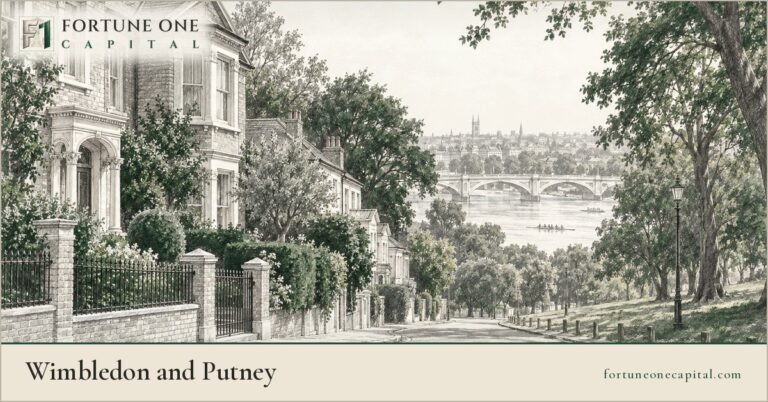
Richmond was a royal town, with a palace by the river and a park of two and a half thousand acres enclosed by Charles I, and it still feels like a town rather than a suburb: a Georgian green, a riverside, a theatre, and the view from Richmond Hill over the bend of the Thames, the only view in England protected by its own Act of Parliament.
Kew, Barnes, Putney and Wimbledon
Kew, with the Royal Botanic Gardens, lies north along the river; Barnes, a village on a loop of the Thames, east; Putney, a Victorian town on the river, beyond it; Wimbledon, with its common and its tennis, to the south-east.
Housing, freehold tenure and planning rules in the south-west
The housing is Georgian and Victorian in the old cores, Edwardian and interwar on the hills and around the commons, with a few new riverside schemes. Almost everything is freehold, and the conservation areas are large but the planning regime is less severe than Westminster’s or Kensington’s. Richmond upon Thames, Wandsworth and Merton are the boroughs.
Property prices in Richmond and the south-west, autumn 2026
The indicative ranges for autumn 2026:
Indicative prices in Richmond and the south-west, autumn 2026
| Property | Indicative price, autumn 2026 |
|---|---|
| Two-bedroom flat in a conversion or riverside block | £550,000 to £1,000,000 |
| Victorian family house, four bedrooms, Putney or Barnes | £1,800,000 to £3,500,000 |
| Detached house with garden, Richmond or Wimbledon Village | £3,500,000 to £8,000,000 |
| Richmond Hill, Kew Green or the Wimbledon Parkside houses | £8,000,000 to £20,000,000 and above |
| Per square foot | £800 to £1,300; Richmond Hill and Wimbledon Village £1,400 to £1,900 |
Source: Land Registry sales and current listings, October 2026; ONS local housing figures, July–August 2026.
The Office for National Statistics puts the average price in Richmond upon Thames at about £803,000 in July 2026, almost unchanged on a year earlier, and the borough is small and consistent enough that the figure means something, unlike the central boroughs’ averages. Wandsworth and Merton are a little lower. Prices here fell less in the 2016 to 2019 prime London downturn than the central districts did, and have risen a little since; the district trades on families’ needs rather than on international capital, which makes it steadier and slower.
Rents and rental yields in Richmond and the south-west
A two-bedroom flat lets for £2,300 to £3,500 a month, a four-bedroom house for £5,000 to £9,000, and the large houses on Richmond Hill or Wimbledon Parkside for £12,000 to £25,000. Richmond upon Thames’s mean private rent was about £2,330 a month in August 2026, up around four per cent on the year. Gross yields are 3.5 to 4.5 per cent on flats and 3 to 3.5 per cent on houses.
The tenant market: families, relocations and the Wimbledon tennis fortnight
The tenant market is families: corporate relocations drawn by the international schools, families waiting to buy, and, in Wimbledon, the tennis fortnight, when a house near the All England Club lets for the two weeks at a figure that covers a month or two of the year. Voids are short in term time. Our guide on letting and managing a London property from the Gulf sets out the agent’s role.
Who buys in Richmond and the south-west
British families moving out of the centre, Americans and Europeans with children at the international schools, and a smaller number of families from the Gulf, India and East Asia who have chosen a house over a central flat.
The Gulf presence is thinner here than in any district in this series, which is both a drawback and the point: a family that wants privacy, a garden, a park and the airport, and does not need the Arab quarter on the doorstep, finds in Richmond a house the central districts cannot offer at twice the price. The investor is rare; the buyer is a family, and the question is nearly always whether the children will be at school here.
Best streets to buy in Richmond, Kew, Barnes, Putney and Wimbledon
Richmond Hill and The Vineyard for the view and the Georgian houses; Kew Green and the streets between Kew Gardens and the river for Georgian and Victorian houses in a village setting; Petersham and Ham for large houses on the river meadows; Barnes’s Castelnau and the streets around Barnes Pond for Victorian family houses; Putney’s West Hill and the streets near the Heath for the larger houses, the riverside blocks for flats; Wimbledon Village and Parkside for the biggest houses by the common, the town for value.
The streets near Richmond station and Putney High Street are busier and cheaper; Twickenham and St Margarets, across the river, are good value and quiet except on rugby days.
Getting about from Richmond: Heathrow, trains and driving into central London
Heathrow is the reason to put Richmond in this series: thirty minutes by car from Richmond or Kew outside the rush hour, by the A316 and the M4, closer than Mayfair, Knightsbridge or St John’s Wood. Richmond station has South Western Railway trains to Waterloo in twenty minutes, the District line to South Kensington in thirty-five, and the Overground east through Hampstead; Barnes and Putney have trains to Waterloo in fifteen; Wimbledon has the District line and trains to Waterloo in twenty. Mayfair is forty-five minutes by car, Harley Street fifty. Every house has parking. The district is one where a family drives, and the roads west are fast.
Schools and hospitals
The schools are the second reason. King’s College School in Wimbledon, St Paul’s and the Harrodian in Barnes, Ibstock Place in Roehampton, Kew House and the Old Vicarage in Richmond, Latymer Upper across the river in Hammersmith, and the German School in Petersham and the Swedish School in Barnes for European families; the International School of London is in Chiswick.
Universities and hospitals within reach of Richmond
For university, King’s College London and Imperial are forty minutes by train, which makes Richmond a less obvious purchase for a student child than Bloomsbury or Kensington. The Royal Marsden’s Sutton site and Kingston Hospital serve the south-west; the private hospitals of central London are forty-five minutes away, and the Cromwell Hospital in Kensington thirty.
Our view on buying in Richmond and the south-west
Richmond and the south-west are for the family that wants a house with a garden, a park, a school and the airport, and will accept that the Gulf’s London, Edgware Road, Knightsbridge and the mosque at Regent’s Park, is forty minutes away.
The value is in a freehold Victorian or Edwardian house on a quiet street within a walk of a station and a school, bought at the per-square-foot price of its neighbours; Richmond Hill, Kew Green and Wimbledon Village carry a premium that holds, and the riverside new-build schemes carry one that has not yet shown it will.
Why we advise renting in Richmond for a year first
This is the one district in the series where the firm advises a family to rent for a year before buying, because the choice of Richmond over Kensington is a choice of a way of life, not of a building, and it is easier to discover in a rented house than an owned one.
Sources: Housing prices in Richmond upon Thames (ONS, July–August 2026) · UK House Price Index (HM Land Registry) · Richmond Park (The Royal Parks). Checked against the Office for National Statistics local housing figures; prices, rents and yields are indicative ranges for that date, drawn from Land Registry sales and current listings, and vary by building and street. General information, not advice on a particular purchase. Figures verified 14 October 2026.
Frequently Asked
Questions about Richmond and the south-west
Thirty minutes by car from Richmond or Kew outside the rush hour, which is closer than any central district; Paddington’s Heathrow Express is quicker from Bayswater, but the drive from Richmond is simpler.
A small one. Families here have chosen the district for the houses, the schools and the parks rather than for a community, and the Arab quarter at Edgware Road is forty minutes away.
Only for a family that wants the house for itself and will keep it; for the child alone, a flat in Bloomsbury or South Kensington is nearer and easier to let afterwards. Our guide on buying a flat for your child studying in London sets out the comparison, and our guide on stamp duty for overseas buyers gives the duty on the prices above.
In autumn 2026 a four-bedroom Victorian house in Putney or Barnes is £1,800,000 to £3,500,000; a detached house with garden in Richmond or Wimbledon Village £3,500,000 to £8,000,000; and the houses on Richmond Hill, Kew Green or Wimbledon Parkside £8,000,000 to £20,000,000 and above. Prices per square foot run £800 to £1,300, rising to £1,400 to £1,900 on Richmond Hill and in Wimbledon Village. A two-bedroom flat is £550,000 to £1,000,000.
A two-bedroom flat lets for £2,300 to £3,500 a month, a four-bedroom house for £5,000 to £9,000, and the large houses on Richmond Hill or Wimbledon Parkside for £12,000 to £25,000. Gross yields are 3.5 to 4.5 per cent on flats and 3 to 3.5 per cent on houses. Richmond upon Thames’s mean private rent was about £2,330 a month in August 2026, up around four per cent on the year. Voids are short in term time.
King’s College School in Wimbledon, St Paul’s and the Harrodian in Barnes, Ibstock Place in Roehampton, Kew House and the Old Vicarage in Richmond, and Latymer Upper across the river in Hammersmith. The German School in Petersham and the Swedish School in Barnes serve European families, and the International School of London is in Chiswick. The schools are the second reason, after Heathrow, to put Richmond in this series.
Richmond Hill and The Vineyard for the view and Georgian houses; Kew Green and the streets between Kew Gardens and the river; Petersham and Ham for large houses on the river meadows; Barnes’s Castelnau and the streets around Barnes Pond; Putney’s West Hill and the streets near the Heath; Wimbledon Village and Parkside for the biggest houses by the common. The streets near Richmond station and Putney High Street are busier and cheaper; Twickenham and St Margarets are good value and quiet except on rugby days.
Richmond station has trains to Waterloo in twenty minutes and the District line to South Kensington in thirty-five; Barnes and Putney have trains to Waterloo in fifteen, Wimbledon in twenty. By car, Mayfair is forty-five minutes and Harley Street fifty. Every house has parking, and the roads west are fast; this is a district where a family drives.
Yes. This is the one district in the series where the firm advises a family to rent for a year before buying, because choosing Richmond over Kensington is a choice of a way of life, not of a building, and it is easier to discover in a rented house than an owned one. The value is then in a freehold Victorian or Edwardian house on a quiet street within a walk of a station and a school.
Yes. The ONS puts the average price in Richmond upon Thames at about £803,000 in July 2026, almost unchanged on a year earlier, and the borough is small and consistent enough that the figure means something. Prices fell less in the 2016 to 2019 prime London downturn than the central districts did and have risen a little since; the district trades on families’ needs rather than international capital, which makes it steadier and slower.